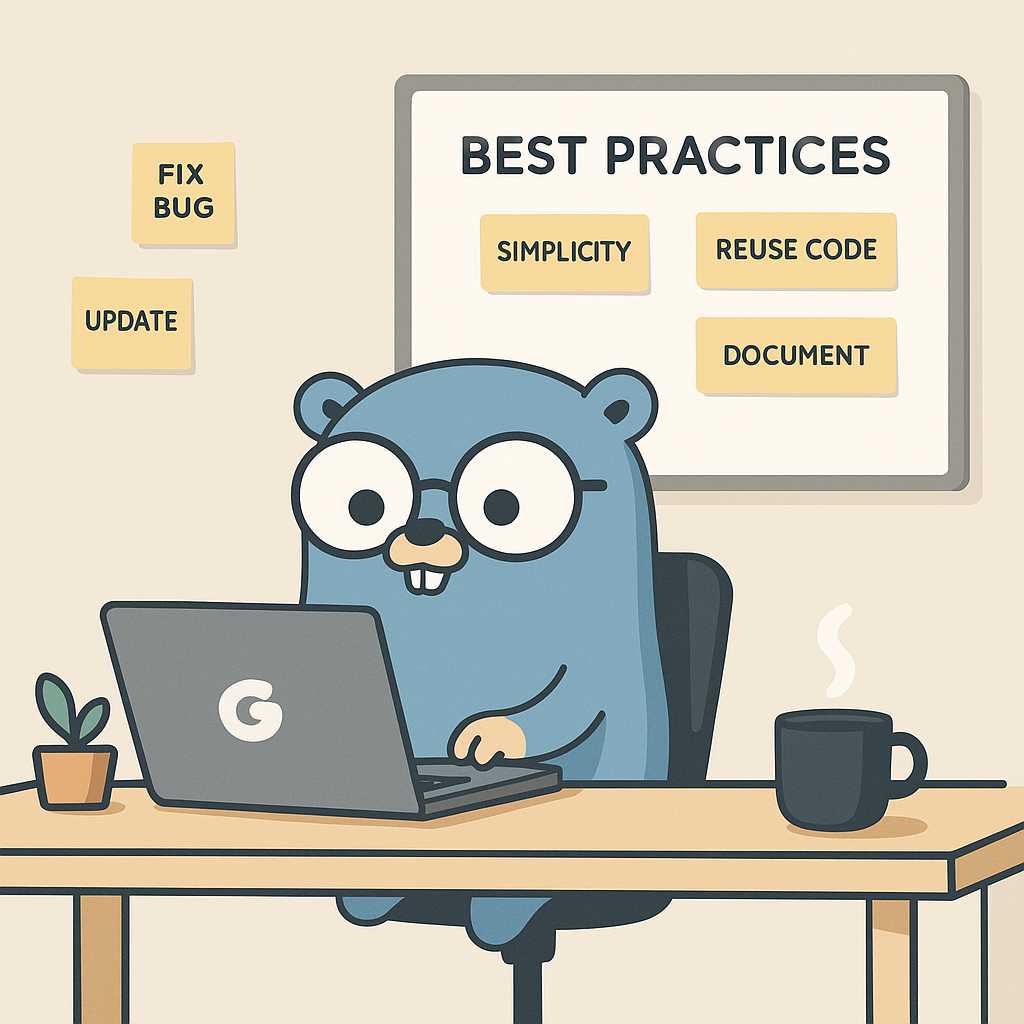

Writing Golang best practices from day one is the foundation for clean, scalable, and maintainable Go applications. Whether you’re building a REST API, CLI tool, or distributed system, applying these best practices ensures your codebase stays readable and robust over time.
In this article, we’ll explore 10 proven Golang best practices every developer should follow — from code structure to error handling and testing.
🔍 1. Follow Idiomatic Go (a.k.a. “Go Proverbs”)
“Don’t just write code in Go — write code like a Go developer.”
Golang has a unique coding culture. Familiarize yourself with:
Use tools like go fmt, go vet, and golint to ensure you’re writing idiomatic Go code. The Go community strongly values consistency.
📦 2. Organize Code into Packages Properly
Avoid dumping everything into a single main.go file.
Bad:
/main.go
Good:
/cmd/myapp
/internal/auth
/internal/user
/pkg/common
Use internal/ for app-specific logic, and pkg/ for reusable libraries.
🔠 3. Name Things Clearly
Use short but descriptive names. Avoid vague or abbreviated terms.
✅ Good: userService, authMiddleware, maxRetries
❌ Bad: svc, x, tmp
For interfaces, prefer behavioral names:
type Reader interface {
    Read(p []byte) (n int, err error)
}
🚦 4. Keep Functions Short and Focused
Each function should do one thing only. Avoid large blocks of logic.
// Bad
func ProcessUserData() {
    // fetch, validate, transform, save – all in one
}

// Good
func FetchUserData() {}
func ValidateUserData() {}
func TransformUserData() {}
func SaveUserData() {}
Follow the Single Responsibility Principle.
🤝 5. Handle Errors Gracefully
Golang doesn’t have exceptions — errors are values.
if err != nil {
    return fmt.Errorf("failed to read file: %w", err)
}
Don’t ignore errors:
data, _ := ioutil.ReadFile("file.txt") // ❌ Bad practice
Use custom error types if needed, and wrap errors with context using fmt.Errorf.
🧪 6. Write Table-Driven Tests
Testing is a core part of clean code. Use Go’s native testing framework.
func TestSum(t *testing.T) {
    tests := []struct{
        a, b int
        want int
    }{
        {1, 2, 3},
        {5, 5, 10},
    }

    for _, tt := range tests {
        got := Sum(tt.a, tt.b)
        if got != tt.want {
            t.Errorf("Sum(%d, %d) = %d; want %d", tt.a, tt.b, got, tt.want)
        }
    }
}
Use t.Run() for sub-tests, and go test -cover to measure coverage.
🧼 7. Avoid Global State
Globals make testing and concurrency harder. Prefer dependency injection:
type Server struct {
    DB *sql.DB
}

func NewServer(db *sql.DB) *Server {
    return &Server{DB: db}
}
🕊️ 8. Concurrency? Use Channels Wisely
Don’t overuse goroutines and channels. Use them only when needed. Prefer sync primitives (sync.Mutex, sync.WaitGroup) when channels are not the best fit.
Remember: “Do not communicate by sharing memory; share memory by communicating.”
📚 9. Keep Dependencies Minimal
Don’t over-engineer. Go has a great standard library.
✅ Good:
import "net/http"
import "encoding/json"
❌ Avoid unnecessary packages for simple tasks.
Use tools like go mod tidy to keep go.mod clean.
🧰 10. Use Linting, Formatting, and Static Analysis
Automate code quality:
go fmt— auto-formattinggo vet— finds suspicious constructsgolangci-lint— all-in-one linterstaticcheck— deep static analysis
Run them in CI to enforce code quality across the team.
✅ Conclusion
Clean code in Go isn’t just about beauty — it’s about readability, testability, and team collaboration. By following these best practices, you write Go code that scales with your project and your team.
“Write code for humans, not just for the compiler.”